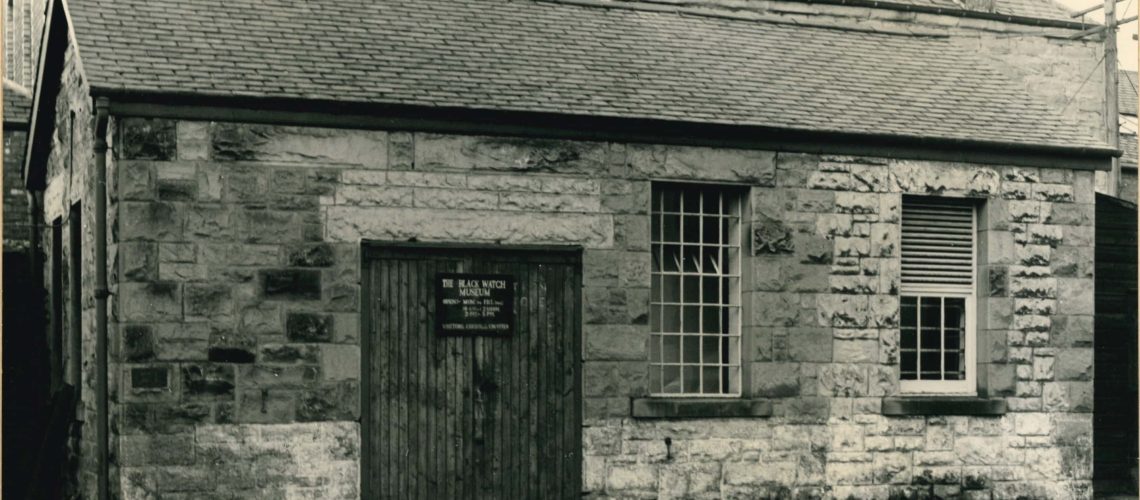
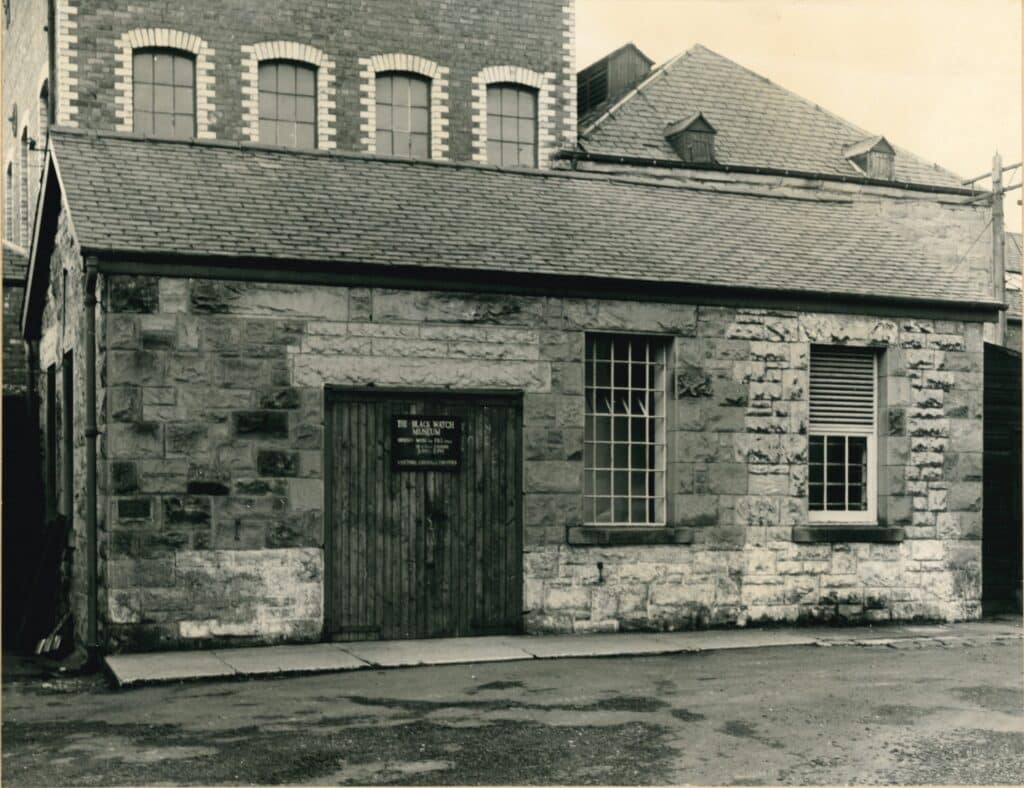

An external building at the Depot used for the museum

From the Ration Store to the Castle: The Origins of The Black Watch Museum

Today marks 63 years since The Black Watch Museum opened its doors to the public at Balhousie Castle. The 5th of February 1963 is, in some ways, the beginning of our story, but it was also the culmination of a long effort to build and house a regimental collection. First established in 1924, this collection has had two previous homes and developed gradually over the past 100 years into the museum we enjoy today. To mark this important anniversary, I will be going back to the museum’s origin in a dusty ration store and taking a decade-by-decade look at some of the key changes that brought us to Balhousie Castle.

1920s

We begin at The Black Watch’s Regimental Depot, Queen’s Barracks in Perth. This is where, in 1924, space was made in a ration store for a collection of treasures from the regiment’s past. Most of these items would have been interesting documents and books belonging to the 1st or 2nd Battalion, which could be given to the Depot for safekeeping. Major William Fowler was largely responsible for organising this rudimentary museum, and in the years to come he also had the job of teaching new recruits about the history and traditions of the regiment as a member of the Recruiting Staff. What sparked the decision to start a museum in 1924?

We should remember that the First World War had only recently concluded, and this period saw the regiment introduce a number of other initiatives focused on remembrance and the importance of tradition. For example, the years between 1919 and 1921 saw the institution of Red Hackle Day as an annual tradition; the opening of The Black Watch Memorial Home at Dunalistair House; and the first publication of the regimental magazine: The Red Hackle.

An external building at the Depot used for the museum

The foundation of a museum was another such effort to ensure that the victories and sacrifices of The Black Watch would always be remembered.

1930s

Under the direction of General Sir Archibald Rice Cameron, a group of serving officers set up a committee in 1932 to oversee the museum’s development. Continuing the work of the previous decade, they wanted to ensure that important pieces of regimental history were brought together at the museum instead of remaining scattered around, and also to provide more room and better shelving for display. A key motivating factor for the work of the Museum Committee was a controversy over the idea that The Black Watch held the exclusive right to wear the red hackle, which was questioned by members of the Duke of Cornwall’s Light Infantry in the early 1930s. Such a debate highlighted the importance of having historical records close at hand, in order to be able to maintain accurate accounts of the regiment’s past and trace the origin of core traditions.

A ‘Museum Notes’ feature was printed in The Red Hackle magazine from 1934 onwards, providing quarterly updates on interesting items acquired and the number of visitors recorded at the museum.

1940s

The museum was closed for the duration of the Second World War and the collection was stored away for safekeeping. When peace resumed, a decision was reached that the museum should have a new home. Separating the museum from the Depot would make it accessible to the public, whereas only military personnel visiting Queen’s Barracks were previously able to enjoy it. Perth Art Gallery was able to provide an exhibition space, and an official opening of the new museum took place in February 1947. Colonel George Archer Rusk and Major ‘Bert’ Chapman took up the first official posts as Museum Director and Curator respectively, both having just retired from distinguished careers in The Black Watch.

Perth Art Gallery was an improvement on the museum’s original situation, but still did not offer the space and sense of permanence required for a regimental collection. By the end of the decade, the contents of the museum were split between the Art Gallery and the Depot Officers’ Mess Quarters – far from an ideal arrangement for staff or visitors! Field Marshal Archibald Wavell published an open letter in 1949, encouraging subscriptions to The Black Watch Museum Fund. This was set up to secure a permanent home for the museum; which should ideally be separate from the Depot, centrally located, and with enough space to accommodate a growing collection.

1950s

While the new Museum Fund grew and plans for the future were still in formulation, day-to-day operations continued and important pieces of Black Watch history continued to be collected. According to Museum Notes for 1954, a grand total of 203 visitors were recorded during the year – some of whom had travelled from India, Australia and the USA. This figure excludes the steady stream of Black Watch recruits who were taken to see the regimental collection as part of their training. It is interesting to note that, as early as 1955, Balhousie Castle had been named by the Museum Committee as an ideal new location, although it was considered that the maintenance costs might make this difficult.

Inside a section of the museum at the Depot
A case displaying uniform and medals from various periods in the Museum at The Queen's Barracks
One of the galleries inside the Museum at The Queen's Barracks

1960s

The question of finding a permanent home for the museum was answered by the decision to close Queen’s Barracks, which had been in service as the Depot since 1873. Balhousie Castle was chosen to become the new Regimental Headquarters and offered spacious accommodation for museum galleries. Queen’s Barracks was decommissioned in May 1961, but it took until March 1962 for the contents of the museum to be moved to its permanent home. The new location brought an opportunity for bigger and better display – enabling the story of The Black Watch to be told chronologically, with each of the five rooms covering a distinct period. Officially opened to the public on the 5th of February 1963, the museum was afterwards open for 6-10 hours a week.

Today’s museum is spread across 11 galleries and open for at least 6 hours a day, 7 days a week. A lot has changed since 1963, but many of the objects on display then still have pride of place today. 

Colonel George Rusk comparing a print to the original painting, after the museum moved to Balhousie Castle
Pioneer statue on display in gallery one at Balhousie Castle which can be seen in one of the photos from the 1950's

Conclusion

From its origin at Queen’s Barracks to the beginning of a new chapter at Balhousie Castle, the museum changed significantly – not only in physical terms but also in its purpose. What started as a way of safeguarding the regimental legacy gradually came to focus more on sharing The Black Watch’s rich history with a wider audience, especially once a public exhibition space was found in 1947. Since opening at Balhousie Castle, The Black Watch Museum has been able to tell the story of the regiment to visitors from Perthshire and all over the world, welcoming around 93,726 visitors in 2025. In celebrating our anniversary, we are thankful for all the hard work, organisation and planning that brought us to where we are today.

The Black Watch Castle and Museum, 2025

Share this post

Leave a comment

Related Posts

This website uses cookies to help ensure you get the best experience.

The Black Watch Logo

This website uses cookies to help ensure you get the best experience.