

The archive at The Black Watch Castle and Museum holds a wide range of material relating to the service of the 42nd Regiment. This includes photographs, records and other items that help us to better understand the men who served.
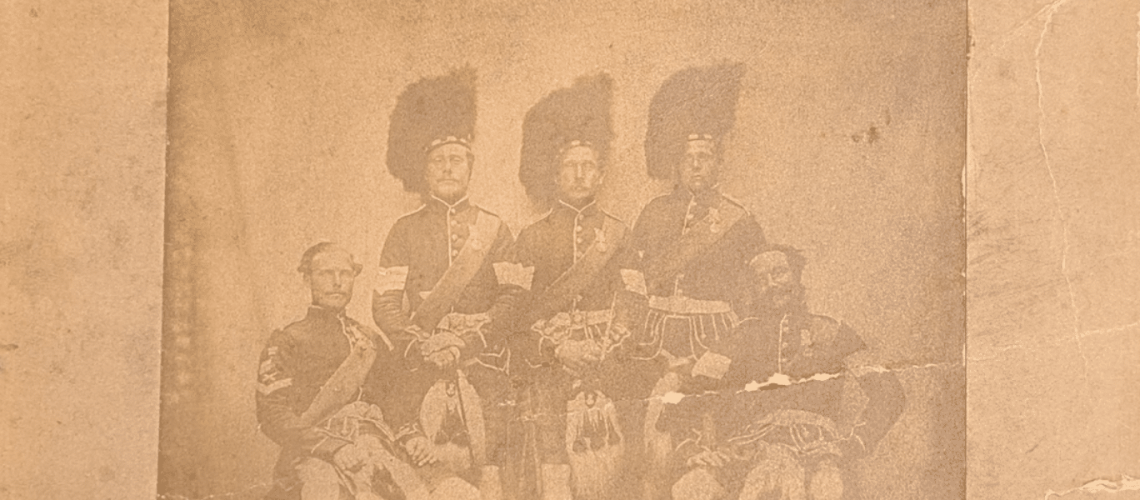
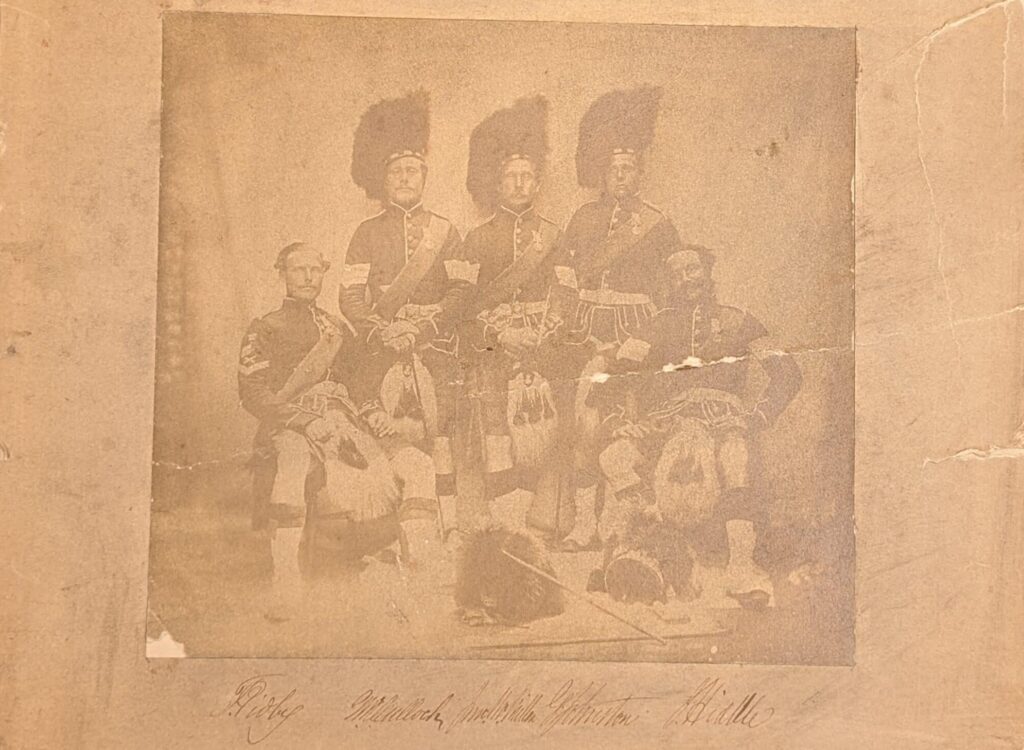
This blog focuses on a photograph of five Sergeants of the 42nd, thought to date from 1857. The image was annotated with surnames only, giving limited information about the individuals shown.
By using sources held within the archive, including the regiment’s Sergeants’ Books, it has been possible to identify these men more fully and add further detail to their service. The following sections outline the records used and what they can tell us, before looking in more detail at the five Sergeants in the photograph.
Sergeants Books
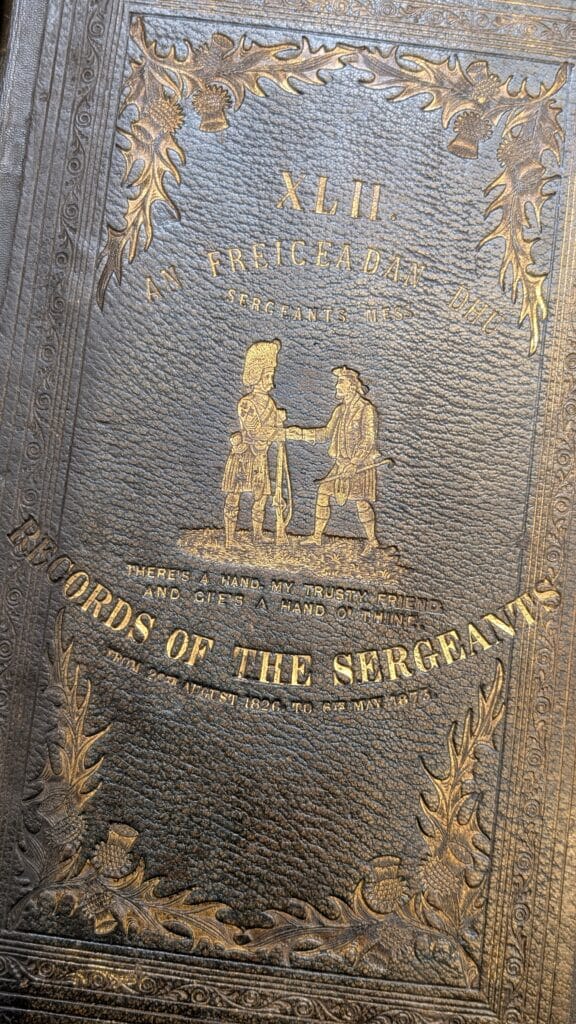
In June 1826 the Horse Guards issued a General Order directing every regiment to form a Sergeants Mess “to support the character and responsibility of their situation”. On 24 August 1826, the Sergeants Mess of the 42nd was formed at Windmill Hill Barracks, Gibraltar.
The regimental archive includes a set of Sergeants’ Books for the 42nd. The first was printed by S. G. Pyke (Army Printer) in 1873 and provides a record of the services of Sergeants from the formation of the Mess in 1826. The book was edited by the regiment’s own Quartermaster-Sergeant and two Colour-Sergeants.
The archive includes the original book, updated versions and equivalent 20th century volumes for the 1st and 2nd Battalions separately. These books are a terrific source of information on the men who served as sergeants, as they quickly summarise their service. In many cases they also provide information that is no longer captured elsewhere or easily accessible.
Both our remote and on-site research services allow family historians, academics and other researchers access to these books. In my role as archivist, I can also use these books to help expand the descriptions of other items in the archive.
Five Sergeants of the 42nd
By using the Sergeants’ Books alongside a Description Book and other records, I have been able to provide further detail on a photograph showing five Sergeants of the 42nd, thought to date from 1857. The image was originally annotated with the surnames Ridley, McCulloch, MacMillan, Johnstone and Hiddle, and it has now been possible to add first names and service numbers to the archive description.
For common surnames, having this extra information greatly helps the museum team to quickly and accurately identify items in our collection relevant to an individual soldier. The records also provide details of each man’s service, including when they were promoted to Sergeant and how their service came to an end. In this case, they reveal that four of the five men died within a year of the photograph being taken, whilst serving in India.
Detailed information about each of the Sergeants is outlined below:
Colour Sergeant Thomas Ridley 2589
A miner from Berwick, Thomas Ridley, joined the regiment in 1848, aged 19. Following several promotions, he reached the rank of Colour Sergeant in 1855 whilst serving in the Crimean War. This was followed by service in India during a period of rebellion. Thomas was dangerously wounded at the Battle of Fort Ruiya (or Rooeya). He died of his wounds two weeks later on 3 May 1858 in Futteygurh. The Sergeants Book tells us that Thomas had married the year before in Dover, but we are not given the name of his wife.
All five men were awarded the Crimean Medal, with clasps for Alma, Balaklava and Sevastopol; Turkish Medal and Indian Medal with clasp for Lucknow. Thomas was also awarded the French War Medal for valour and discipline.
Sgt George McCulloch 2691
Like Thomas, George McCulloch enlisted in 1848. He was promoted to Corporal six years later and was made Sergeant at the end of 1855. Again, this promotion comes during service in the Crimean War. His entry in the Sergeants Book is brief and George is simply noted as having died of “Fever” at Lucknow, India on 9 April 1858. We aren’t told how old he was or where he was from.
All five men were awarded the Crimean Medal, with clasps for Alma, Balaklava and Sevastopol; Turkish Medal and Indian Medal with clasp for Lucknow. Thomas was also awarded the French War Medal for valour and discipline.
Sgt George Johnstone 2573
George Johnstone was a servant, just short of his 18th birthday, when he joined the regiment in 1848 in Glasgow. Although he has a very similar service to the other men in the photograph, George is the only one to survive his time in India and return to civilian life. He was discharged at Stirling Castle in 1860. However, the Sergeants Book notes that he was employed drilling Glasgow Rifle Volunteers at Rutherglen.
Sgt John Hiddle 2552
Like George Johnstone, John Hiddle also joined the regiment in 1848 in Glasgow. He was a 20 year old glazier born in Leith, Edinburgh. His promotions didn’t begin until 1855, during his service in the Crimean War. This was followed by annual promotions bringing him up to Sergeant in 1857. The Sergeants Book notes that he was wounded at Lucknow on 11 March 1858 and died months later of fever on 31 May at Bareilly.
Sgt John McMillan 2233
John McMillan enlisted in 1843, five years earlier than George McCulloch and Thomas Ridley. He was an 18 year old groom from Kirknewton, near Edinburgh. John was promoted to Corporal twice having been reduced to Private for a period in 1849. Despite this, he was made Sergeant in 1856. During his service in India, John died suddenly on 22 May 1858 from sunstroke in Bareilly. The British forces struggled with the extreme heats. Illness and death from sunstroke was not uncommon.
Conclusion
Less than two years after the Crimean War, the 42nd was sent to India, where a rebellion had broken out against British rule. Tensions had been brewing for a long time between the local population and the East India Company, which controlled British interests in the subcontinent, fuelled by long-term concerns that the British were trying to convert the Indians to Christianity. The Gazette listed returns of British casualties at Lucknow for 10-15th March 1858. Sgt John Hiddle was one of 367 wounded. 71 officers and men were killed. We do not know an equivalent figure for those defending the city, but many thousands were killed during the years of rebellion. Civilians and the families of British forces were not spared. Atrocities were committed by both sides. Though frequently referred to as ‘The Indian Mutiny’, the conflict is also known as ‘The First War of Independence’ or ‘The Indian Rebellion’.